Latest · Analysis
Cents on the Mile: Ming Maps Cybercab's $50,000 Head Start Over Rival Robotaxis
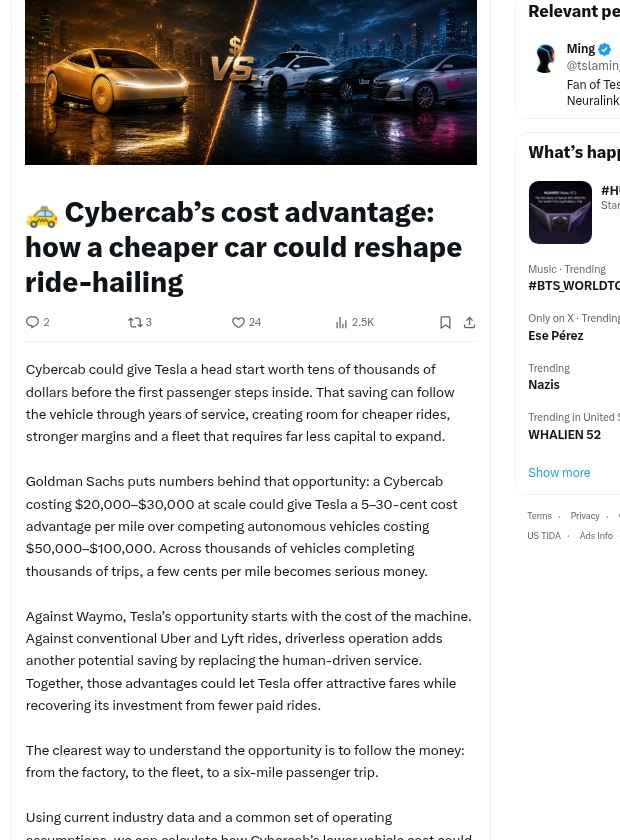
Ming compares Goldman Sachs's $20,000-$30,000 Cybercab range with $50,000-$100,000 rival AVs, then models about 21 cents less capital per paid mile - and cites an Austin fare already under Model Y.

AUSTIN, Texas - Ming (@tslaming) filed a long X Article overnight that treats Cybercab as a capital story first. He cites Goldman Sachs's reported $20,000-$30,000 at-scale Cybercab price against competing autonomous vehicles at $50,000-$100,000. He then models a cost edge of about 5 to 30 cents per mile that grows across a fleet.
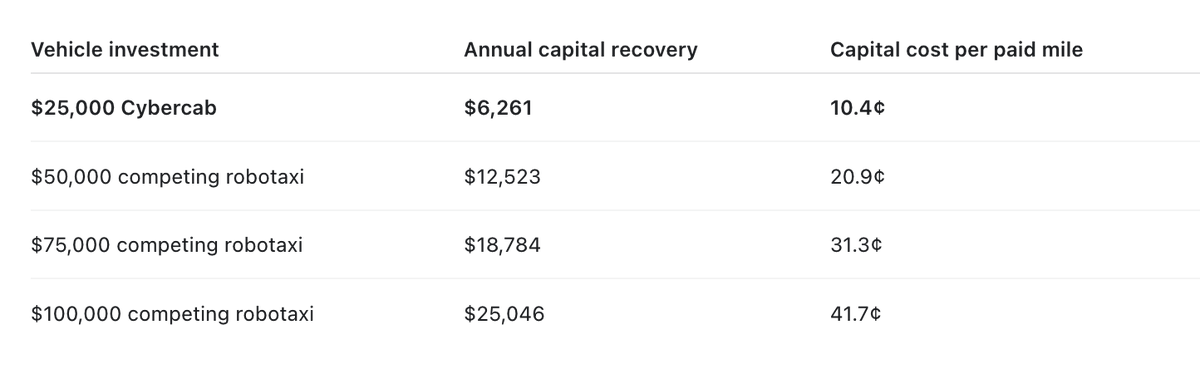
His midpoint case is direct. Put Cybercab at $25,000 and a rival at $75,000 and Tesla starts with a $50,000 gap on every car - $5 billion across 100,000 vehicles - before the first fare. Cybercab.news is leading with the piece because Austin riders already see cheaper unsupervised miles in the app. Ming asks whether the cheaper machine can keep that gap after financing, empty miles, and depot work. Every dollar figure below belongs to Ming's model or to the Goldman ranges he cites. The desk is not building a second spreadsheet.
Ming keeps the operating assumptions simple so the hardware gap stays clear. Each vehicle runs five years and 100,000 miles a year. Sixty percent of those miles are paid - 60,000 paid miles a year. At a six-mile average trip, that is about 10,000 rides a year, or roughly 29 rides per operating day across 350 days. Financing is modeled at 8 percent with equal recovery over five years.
Under those rules, Cybercab's annual capital recovery is about $6,261, or 10.4 cents per paid mile. The $75,000 midpoint competitor recovers about $18,784 a year, or 31.3 cents per paid mile. The spread is roughly 21 cents per paid mile - about $1.25 on a six-mile trip, and roughly $12,500 a year per vehicle across 10,000 trips - from vehicle investment alone.
He then holds operating budgets constant so the cheaper car is not getting a free pass on cleaning, electricity, insurance, or human support. With shared opex allowances added, Ming's midpoint comparison shows about a 20 percent lower modeled total cost per ride for Cybercab versus the $75,000 alternative. At the base 29 daily rides, his figures put Cybercab near 86 cents per paid mile against about $1.07 for the rival.
Flip the question and ask how little work Cybercab needs to match that rival's cost: about 23 six-mile rides a day. Grow from 23 toward 29 and the modeled edge moves back toward that 20 percent undercut. Utilization still matters. At only 40,000 paid miles a year, the same annual budget blows past the competitor's per-mile figure. The head start is real. It is not unlimited.
Austin already offers a passenger-facing check. Ming cites a David Moss clip that quotes Cybercab at $7.77 and a Model Y at $12.10 on the same route - a $4.33 gap, nearly 36 percent. That is not Ming's full cost model, and it is not a national tariff. It is an early wallet check that fits the thesis: a purpose-built coupe with less metal to amortize has more room to post an attractive fare while still recovering capital.
Tesla's design brief, as Ming recounts it, is why the cost gap is meant to hold. Unboxed manufacturing builds large modules in parallel before joining them, which is meant to cut factory time and space. The two-seat layout narrows the engineering task versus a family AV. Camera-based perception thins the sensor bill. An efficient powertrain - Tesla once estimated about 5.5 miles per kWh for Cybercab - can shrink the battery pack needed for a given range. Each dollar designed out of the vehicle is a dollar the fleet does not have to reclaim from riders.
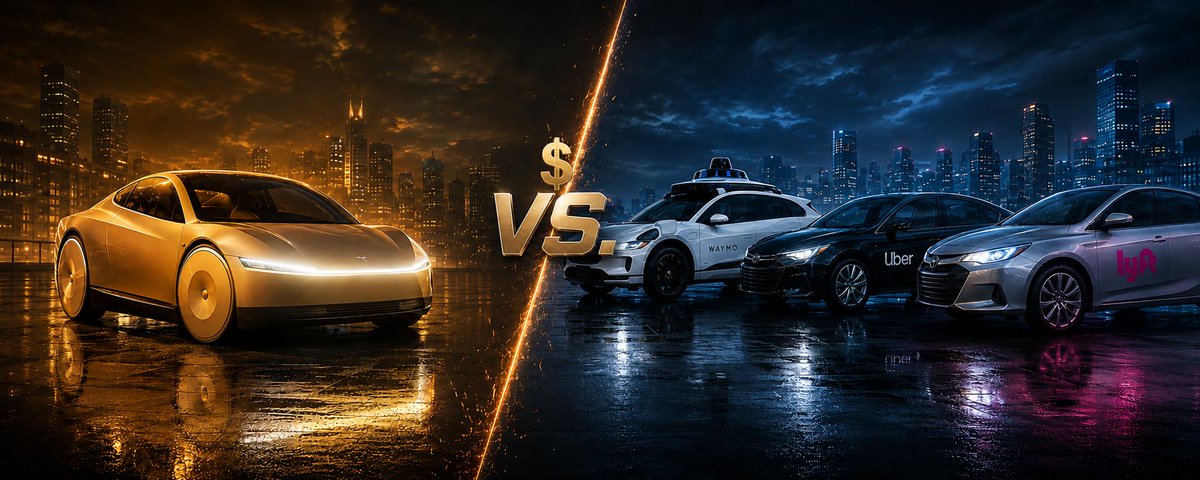
Against Waymo-class hardware, Ming says the fight starts with the cost of the machine. Against Uber and Lyft, driverless operation removes another human-wage layer. Those are the levers Tesla wants for both cheaper rides and healthier margins.
Fleet context keeps the model honest about scale still ahead. Axios reporting Ming cites put 45 Cybercabs inside a 420-vehicle Texas robotaxi registration count at launch - preparation inventory, not a finished national network. On September 4, NHTSA opened a self-certification inquiry into Cybercab's safety-standard path. Ming flags that probe as an immediate regulatory milestone for expansion. None of that cancels the unit-economics argument. It reminds readers that capital advantage has to survive production, certification, and utilization before it becomes everyday habit.
The desk is filing Ming's analysis as desk attribution, not as Tesla IR. Goldman ranges arrive as Ming reports them via Investing.com and Yahoo Finance dated September 6, 2026. The midpoint math, paid-mile assumptions, and Austin fare anecdote are his. What Cybercab.news adds is the local frame: riders in Austin are already choosing between Cybercab and Model Y unsupervised trips, and the cheaper machine is the product Tesla built to make cents-on-the-mile a durable business, not a launch-week stunt.
If Ming's bullish read holds, the $50,000 head start is not a press-kit flourish. It is the difference between recovering capital at roughly 10 cents a paid mile or more than 30 - and between needing roughly 23 busy days to break even on cost with a pricier rival or banking a modeled 20 percent edge at a fuller 29. Cheaper car. Fewer parts. More room on the fare. That is the Cybercab cost brief as mapped overnight by Ming, and it is why the two-seater's economics matter as much as its missing wheel.
Harper Quinn is a senior correspondent covering Robotaxi launches, Austin fleet ops, and the day-to-day of Cybercab rides. Previously reported transport and consumer tech for independent trade titles; based in Austin.