Latest · The wire
The Car Is Real. Building the Service Is the Hard Part.
On the eve of Tesla’s Austin guest night, WIRED and Reuters published the same caution.
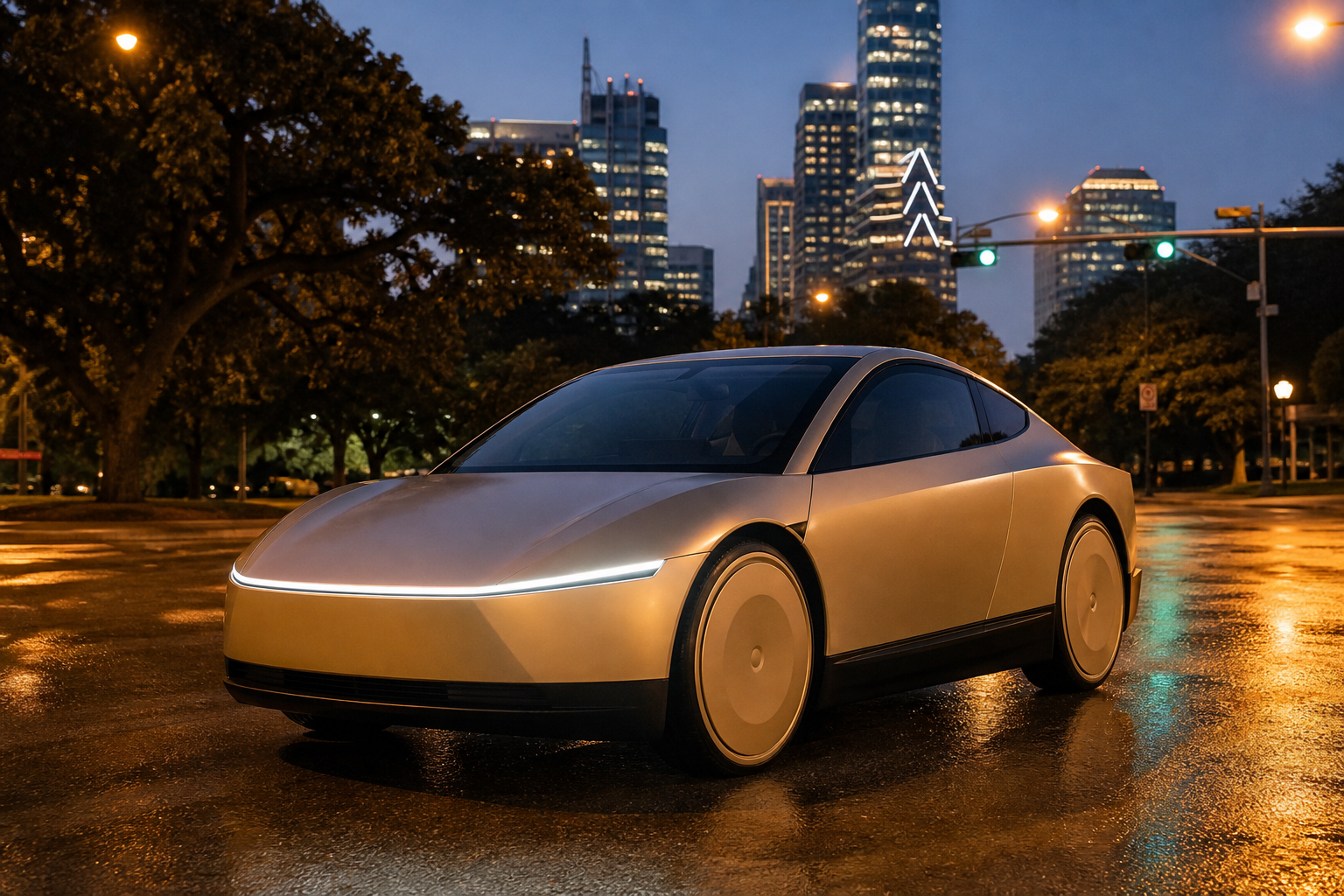
AUSTIN, Texas — Tesla’s invite-only Cybercab night is less than a day away. On Wednesday, two national outlets published the same caution in different registers: the car is real, the guest list is set, and the difficult work of running a wheel-less robotaxi service is mostly still ahead.
WIRED’s Aarian Marshall, in a piece published Wednesday morning, put the thesis in the headline. The matte-gold, steering-wheel-free Cybercab is about to get more public attention at Tesla’s Austin headquarters on Thursday. Building that vehicle, Marshall wrote, may be the easier lift. Running a scaled autonomous ride-hail service, and proving the software that powers it, is harder. Morningstar analyst Seth Goldstein told WIRED that software is “the most important piece” longer term, and that production only matters if the cars can navigate safely.
Reuters, in a San Francisco factbox the same day, listed what Tesla has still not answered in public. The company has not announced a start time for Thursday’s event. It usually livestreams major product nights, Reuters noted, but it has not officially confirmed a stream for this one. Tesla has marketed the evening as “Exclusive Access: Cybercab” and invited selected Robotaxi riders and other guests. It has not published a detailed program for what kind of launch those guests will see.
That gap matters because secondary coverage has already filled it in. Electrek and other outlets have reported that Tesla will livestream the night and that Cybercab will become available to hail through the existing Robotaxi app in Austin. Tesla’s own Robotaxi page, checked Wednesday afternoon London time, still separates those claims from company copy. It lists unsupervised Model Y rides in Austin, Dallas, Houston, Miami, Orlando and Tampa. Of the purpose-built car it says only that “Cybercab, our purpose-built fully autonomous vehicle, will offer rides in your area in the future.”
Reuters also restated a report from The Information last month: Tesla told staff it planned to begin the rollout with employee rides on public roads, then fold Cybercabs into the Austin Robotaxi service a few days later. That sequence, if it holds, would make Thursday an opening act rather than a citywide hail date. Tesla has not contradicted the reporting in a formal statement, and it has not published a public-hail calendar for Cybercab.
The regulatory file is similarly incomplete. Reuters wrote that Tesla has not said whether it has received the approvals it needs, or whether it has determined that a commercial Cybercab service complies with federal safety norms. Texas already authorizes Tesla Robotaxi, LLC as a commercial automated-vehicle operator under the state’s self-certification framework. Community trackers reading the Texas Motor Carrier Credentialing System this week put about 45 Cybercabs on that list under 2026 VINs with a 5YJA prefix, alongside roughly 269 Model Y robotaxis. A listing clears a state paperwork step. It is not, by itself, a fare in the app.
WIRED’s count was slightly higher, saying Tesla had added 51 Cybercabs to its Texas-registered fleet before the event, with 263 Model Ys also registered. The discrepancy was not reconciled in public sources by Wednesday evening. Either figure is a small commercial fleet next to Waymo’s paid network, which The Verge has described as operating in more U.S. cities with hundreds of thousands of trips a week. Treat the Texas numbers as an authorized inventory, not a simultaneous street count.
Tesla’s own executives have set a louder public tone than the website. Ashok Elluswamy, Tesla’s head of AI software, posted last month that “the streets won’t be the same anymore,” according to WIRED. When a user asked whether Cybercabs would “flood Austin,” Elon Musk replied “Yes,” WIRED reported. Those lines are ambition. They are not an app toggle.
Marshall’s piece is useful because it separates hardware theater from fleet economics. Waymo and others have hired outside partners to clean, charge and stage vehicles. Tesla prefers to do more of that work itself. A Texas architectural permit filing from 2025 pointed to a “cleaning robot” at a robotaxi hub, WIRED noted, but Tesla has not published operating details beyond promotional material. Utilization, charging, cleaning and repair decide whether a robotaxi makes money once the cameras stop for the photo.
Safety history hangs over the same night. Reuters noted that Tesla’s supervised Full Self-Driving system has faced federal investigations and lawsuits after collisions, and that a version of FSD that does not require a supervising driver is what runs Cybercab. Tesla has said FSD is already many times safer than human drivers. WIRED reminded readers that NHTSA’s investigation into FSD crashes opened in 2024 and remains open. Waymo’s Aug. 26 blog argued that “cameras aren’t enough” and did not name Tesla; the timing still lands next to a camera-only Cybercab debut.
None of that erases what Thursday can show. Production Cybercabs have been on public Austin streets. Employee campus rides began in July, per Tesla’s own disclosures. A first-responder interaction plan published by Tesla describes Cybercab Robotaxi as an SAE Level 4 system with bookings, roaming and lightbar pickup cues. Guests who are 21 or older, with RSVPs already closed, may ride a car with no wheel and no pedals. That would be a real step even if the Robotaxi app still offers Model Y only on Friday morning.
Judge the night on what Tesla demonstrates, not on what secondary headlines have already assumed. Watch whether rides leave the campus for public Austin roads. Watch whether Tesla names a date for Cybercab inside the Robotaxi app. Watch whether the company publishes a time and a stream, or keeps the evening inside the guest room. The car on the lot is no longer the story. The service that has to follow it is.
Harper Quinn is a senior correspondent covering Robotaxi launches, Austin fleet ops, and the day-to-day of Cybercab rides. Previously reported transport and consumer tech for independent trade titles; based in Austin.
This article is based on reports of internal communications and publicly available information.
More on the wire
Breaking
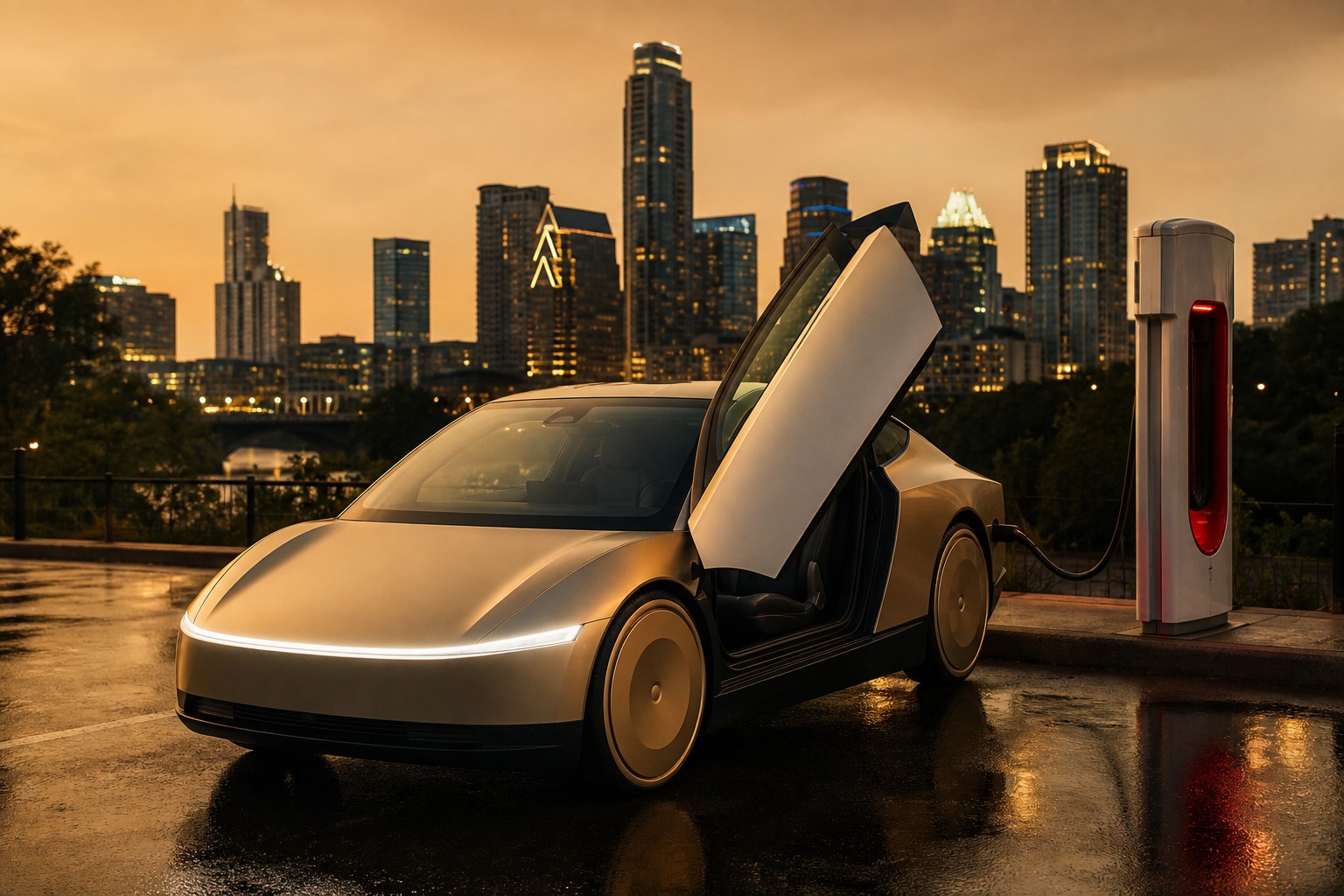
No Wall Connector: Cybercab Is Built for Fleet DC, Not Driveways
Harper Quinn · 1d ago
Breaking
Cents on the Mile: Ming Maps Cybercab's $50,000 Head Start Over Rival Robotaxis
Harper Quinn · 1d ago
Breaking
Fake Warrant, Real Ride: Jeremy Judkins Scripts Grok Into a Cybercab Police Prank
Harper Quinn · 2d ago