Latest · Breaking
Look Both Ways: Cybercab Won't Open Doors Into Passing Traffic
Whole Mars Catalog films the two-seater refusing a butterfly door while a pedestrian walks past - red camera warning, Hold to Override on screen, then a slow open once the curb clears.
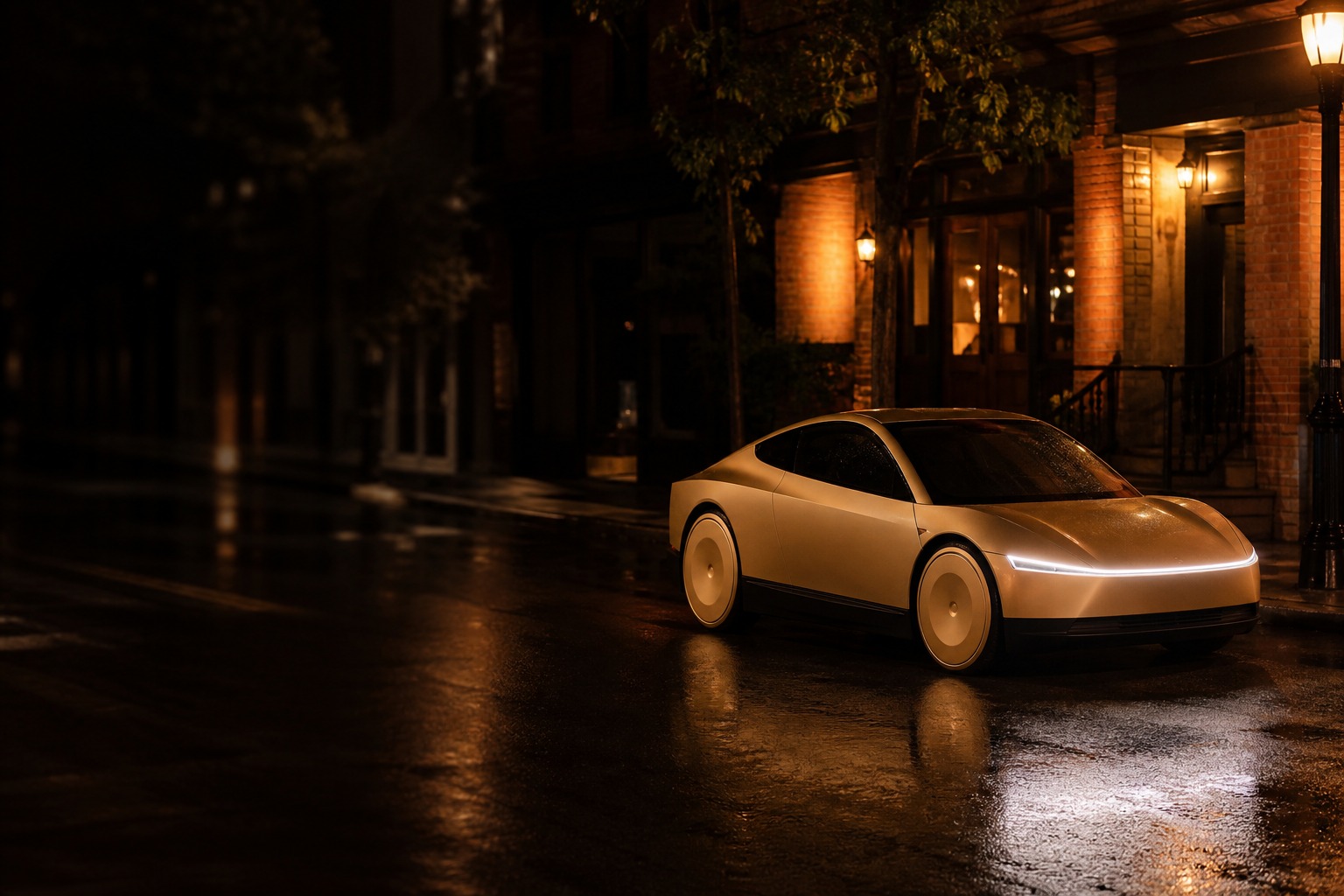
AUSTIN, Texas - In a city where Cybercab is already taking fares without a steering wheel, the next safety detail is not about how the car drives. It is about how it lets you leave. Whole Mars Catalog, the high-follower Tesla account that posts as @wholemars, published a short cabin video on Sunday morning showing the purpose-built two-seater holding a butterfly door closed while a pedestrian walks past the right flank - then opening only after the curb clears. The caption is blunt. "Cybercab's doors won't open if there are pedestrians, cyclists, or cars passing by," the post reads. "You can hold down to override, and the door will open slowly." (The original line says "openly," which reads as a typo for "open.") Within hours the clip had crossed roughly 40,000 views.
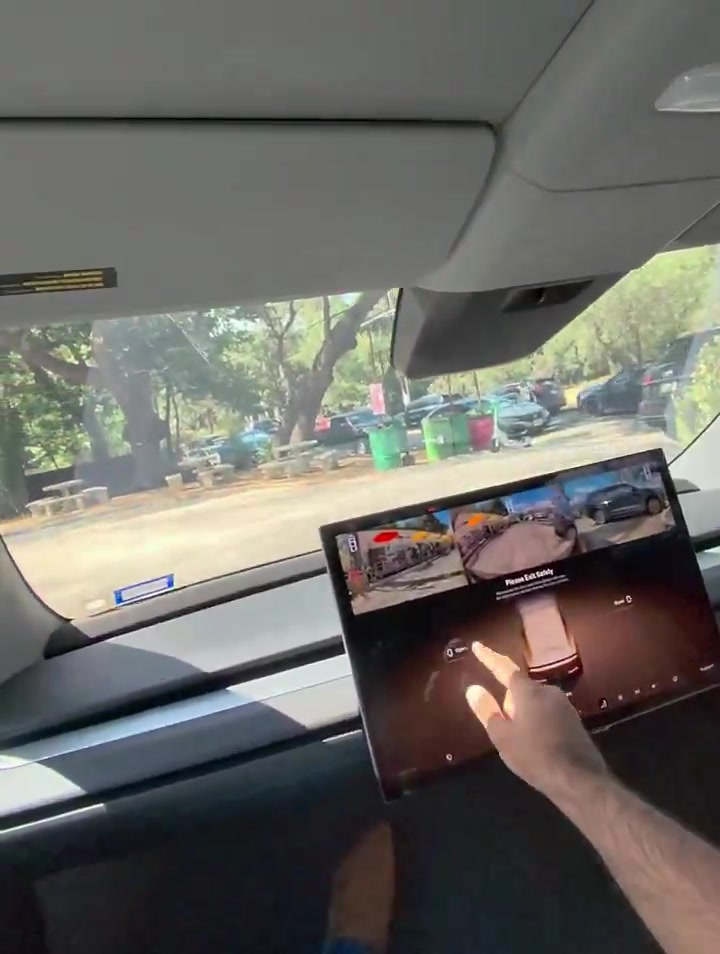
The film is shot from inside the cabin on what looks like a busy Texas curb: a blue state registration sticker on the windshield, a Ford F-150 with a Texas plate, yellow patio umbrellas, walkers on both sides, a scooter earlier in the approach. There is no wheel. While the car is still moving, the center screen plays Pink Floyd's "Breathe (In the Air)." When it stops, the UI flips to work mode - left, rear, and right camera tiles, a 3D Cybercab graphic, and a "Please Exit Safely" prompt with a Hold to Override control beneath it.
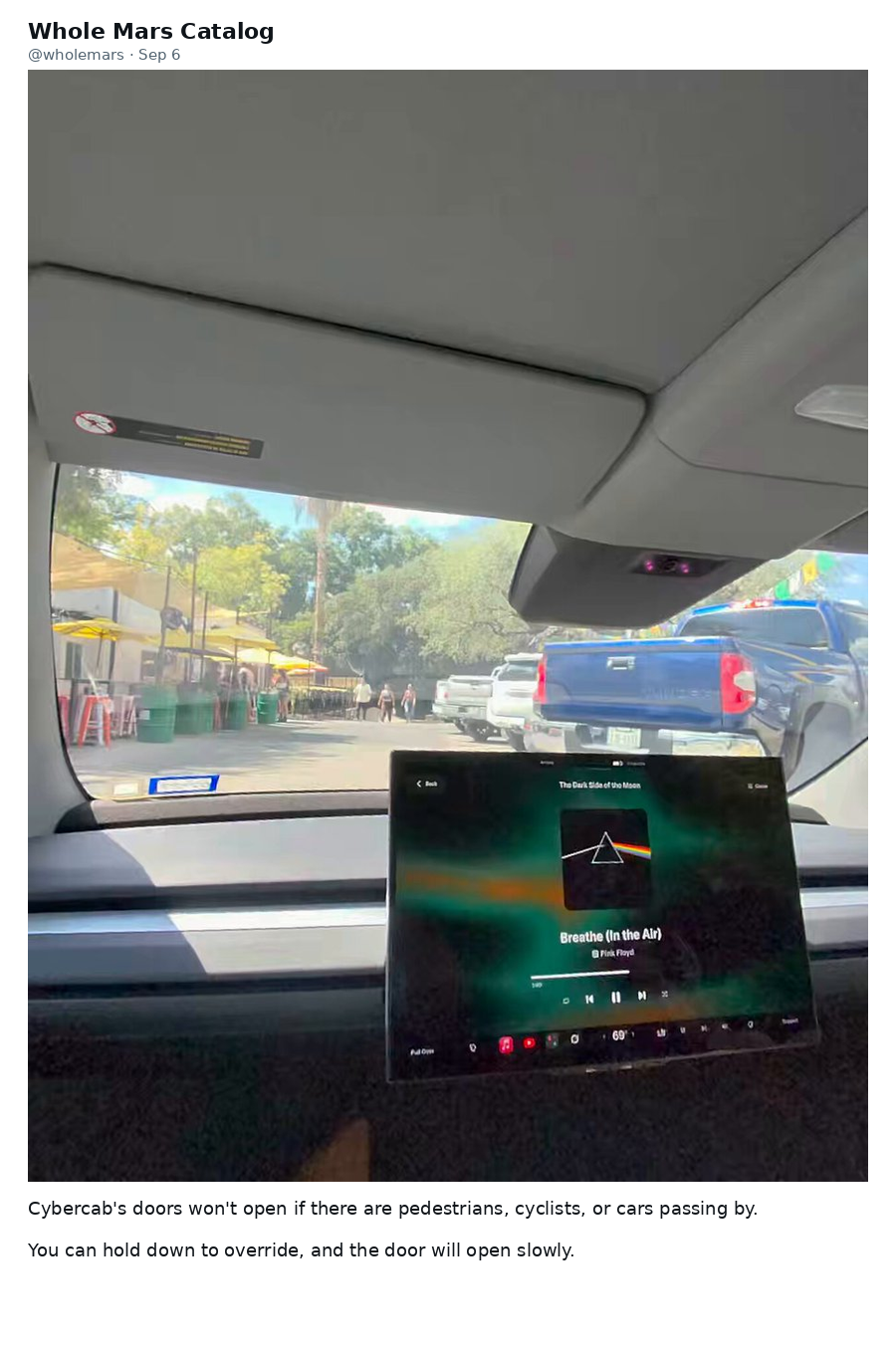
That is when the product beat lands. A passenger taps Open while someone is walking past the right side of the car. The right camera feed picks up a red border and a warning triangle. The door stays shut. On the audio track, the cabin narrates itself better than any press note: one rider says they love the doors; another calls them a favorite part; then, after the blocked tap, "Oh, see I pushed open, but there was someone walking by so it didn't open." Once the pedestrian clears, the butterfly door rises in about two to three seconds - paced, not snapped. The Hold to Override button is visible in the clip; the riders do not use it. The default wins.
What Whole Mars is documenting is the soft edge of unsupervised service. A butterfly door that arcs into a bike lane or a passing walker is not a design flourish; it is a liability. Tesla's answer, as shown here, is to treat the door like another sensor-gated actuator. The car watches the flanks. If the path is dirty, the door stays shut and the screen tells you why. If the rider still needs out - a curb that never fully clears, a late pickup, a personal urgency - a sustained hold overrides the lockout and the door moves slowly enough that nearby traffic can react. That is the same philosophy that put Pull Over on the dock and Starlink on the roof: keep the cabin useful, and keep the street safer than a hurried human would.
For Austin riders this week, the detail lands beside other Cybercab habits already in the wild. RGB pickup lights tell you which coupe is yours. Occupancy sensors watch for child seats. The app can ask Cybercab or Model Y. Fares move with demand. None of that matters if the first step out of the car is into a cyclist. Door gating is the kind of quiet systems work that never makes a keynote reel and always shows up in the first week of public rides - when people film the screen, press Open, and discover the car has opinions about the sidewalk.
The clip also underlines how much of Cybercab's safety story now lives on the display. Camera strips along the top of the screen give left, rear, and right views at the moment of exit. A red border is not a mystery. It is the same perception stack that drives the vehicle, shown to the people who are about to step into it. Hold to Override is the escape hatch for edge cases without abandoning the default that protected space comes first.
Tesla has not published a full technical brief on door logic in the same way it has teased cleaning robots or inductive charging. Whole Mars is not claiming an official release note. The desk files the post as field evidence from a trusted chronicler of the Robotaxi beat: in active Cybercab cabins, door open is gated on clear flanks, the UI flags the blocked side, and override is deliberate and labeled. That matches the broader Cybercab brief - a utilization machine that still behaves like a vehicle sharing a city, not a private garage toy.
For fleet operators watching ownership math and for parents reading the under-13 rules, the door behavior is another data point that the product is being tuned for public streets. Slow opens and blocked swings are the opposite of a gotcha. They are how a wheel-less coupe earns the right to idle at a curb while classic rock plays on the cabin screen and walkers cut between trucks.
Cybercab's Austin week has been a parade of product truths: no wheel, more room, fares that surge, seats at wheelchair height, Grok in the cabin, Netflix on a big pane. Sunday's Whole Mars clip adds a quieter truth. The doors listen first. Then, if you insist, they open slowly.
Harper Quinn is a senior correspondent covering Robotaxi launches, Austin fleet ops, and the day-to-day of Cybercab rides. Previously reported transport and consumer tech for independent trade titles; based in Austin.
Source: https://x.com/wholemars/status/2096502286457450938
More on the wire
Breaking
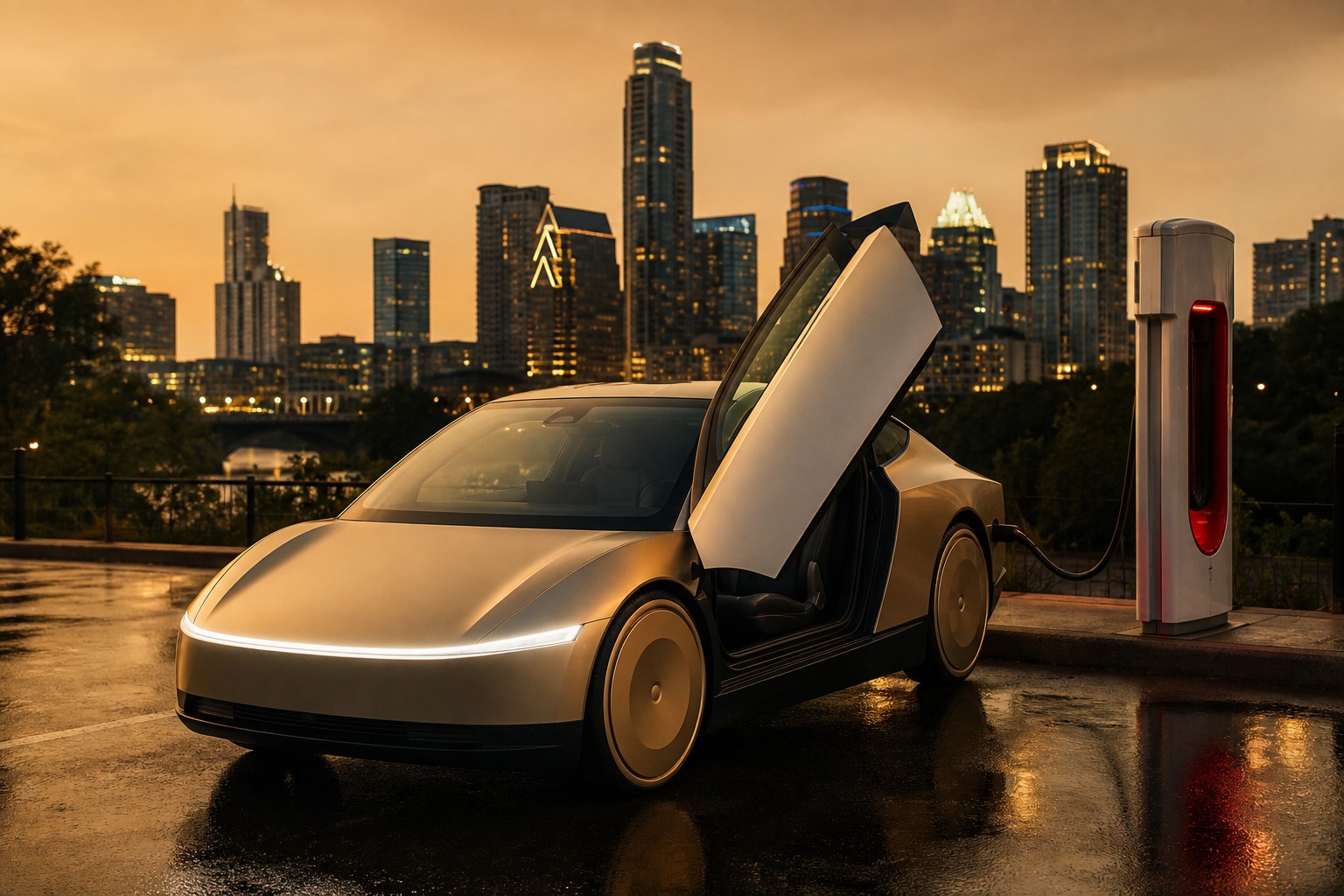
No Wall Connector: Cybercab Is Built for Fleet DC, Not Driveways
Harper Quinn · 1d ago
Breaking
Cents on the Mile: Ming Maps Cybercab's $50,000 Head Start Over Rival Robotaxis
Harper Quinn · 1d ago
Breaking
Fake Warrant, Real Ride: Jeremy Judkins Scripts Grok Into a Cybercab Police Prank
Harper Quinn · 2d ago