Policy · Policy
Why NHTSA's Cybercab Audit Could Be a Win for Tesla
Cern Basher argues AQ26002 is not a defect finding. A clean answer could become precedent for a car that never had a driver’s station.
AUSTIN, Texas - Six months before Tesla put wheel-less Cybercabs into paid Austin service, NHTSA Administrator Jonathan Morrison told the National AV Safety Forum that future vehicles are still “tethered to the regulations of the past,” and that a car built never to be driven “doesn't get safer because it has a foot pedal.”
The Open Audit Query opened the same day as Cybercab's commercial debut - AQ26002, covering about 1,000 vehicles - is not a defect finding and has not stopped Robotaxi hails. It asks whether Tesla's self-certification correctly treats some human-control Federal Motor Vehicle Safety Standards as inapplicable. If that reading survives federal scrutiny, Cybercab could gain something rarer than a temporary exemption: early regulatory precedent for a purpose-built autonomous car, while NHTSA finishes FMVSS updates it says will “unleash American innovation” in the coming months.
That constructive reading of a hard-looking headline was laid out Saturday in an X Article by Cern Basher, the Tesla-focused commentator @CernBasher, titled “Why NHTSA's Cybercab Investigation Could Be a Very Good Thing.” The piece sits beside Cybercab.news's earlier report on the audit itself. The news is not that Washington opened a file. The news is what kind of file it is, and what a clean answer would unlock for a vehicle that never had a driver's station.
In the U.S. system, automakers generally self-certify compliance with FMVSS. NHTSA can examine that work after the fact. Tesla told the agency it certified Cybercab as meeting all applicable standards. NHTSA's Office of Defects Investigation opened AQ26002 on Sept. 3, “prompted by public information,” to review the process and technical data behind that certification and how far it rests on determinations that certain standards simply do not apply to a vehicle with no steering wheel, pedals or conventional mirrors. The agency has not declared Cybercab noncompliant, has not ordered controls reinstalled, has not required an exemption and has not halted Austin deployment, according to Electrek, TechCrunch, CNBC and Business Insider accounts of the filing.
On the day AQ26002 became public, Morrison struck a similar balance. “NHTSA fully supports the safe development and deployment of automated vehicles. But as the federal regulator, we need to ensure that all of our laws are followed,” he said in a statement quoted by TechCrunch. “Our approach of balancing innovation with safety oversight will allow the United States to maintain its global leadership in AV innovation.”
For Tesla, the upside of early scrutiny is practical. Cybercab is already in the Robotaxi app in limited areas of Austin. Public rides opened Friday and were moved up to 2 p.m. Central on demand after the invite-only launch. Texas still listed dozens of Cybercabs on Tesla Robotaxi's commercial roster beside hundreds of Model Y robotaxis. An audit that tests the legal theory before the fleet scales into the tens or hundreds of thousands removes overhang that would only grow harder to carry later. Surviving that test would be stronger than Tesla asserting the case alone.
The cautionary contrast is Zoox. Amazon's robotaxi unit also self-certified a purpose-built vehicle without traditional controls. NHTSA opened Audit Query AQ23001 in March 2023 after a Special Order. The agency later documented apparent FMVSS noncompliances, closed the audit in August 2025 after a demonstration exemption, and in July 2026 granted Zoox a temporary Part 555 exemption capped at 2,500 exempted vehicles per year through July 2028 before paid Las Vegas rides began. That path worked. It also depended on discretionary exemptions - exactly the business model Morrison warned against. Tesla's AQ26002 has not produced a Zoox-style noncompliance finding. The open question is whether Cybercab's “applicable standards” reading holds without needing the same corridor.
NHTSA is not standing still on the rulebook either. With the Cybercab query, the agency said it is updating parts of the FMVSS that relate to manual controls and looks forward to finishing that work “in the coming months,” while stressing that existing standards remain in force until then. Federal Register notices in March 2026 already proposed exceptions for ADS vehicles without manual controls from shift-position display rules and from certain defrost and wipe standards. Further agency work has targeted lighting, tire placards and brake-pedal mandates for vehicles designed never for human operation, while keeping stopping-distance performance. The modernization track and the audit are not the same thing. Together they sketch how Washington wants purpose-built AVs to fit the code rather than forever borrow around it.
None of that means AQ26002 is a formality. Tesla must still show its work. The query covers an estimated 1,000 Cybercabs and sits separate from NHTSA's Engineering Analysis into supervised Full Self-Driving in reduced visibility on consumer cars. Cybercab's Robotaxi software branch is not that consumer supervised build. The new file is about hardware certification of a car that never had a driver's station.
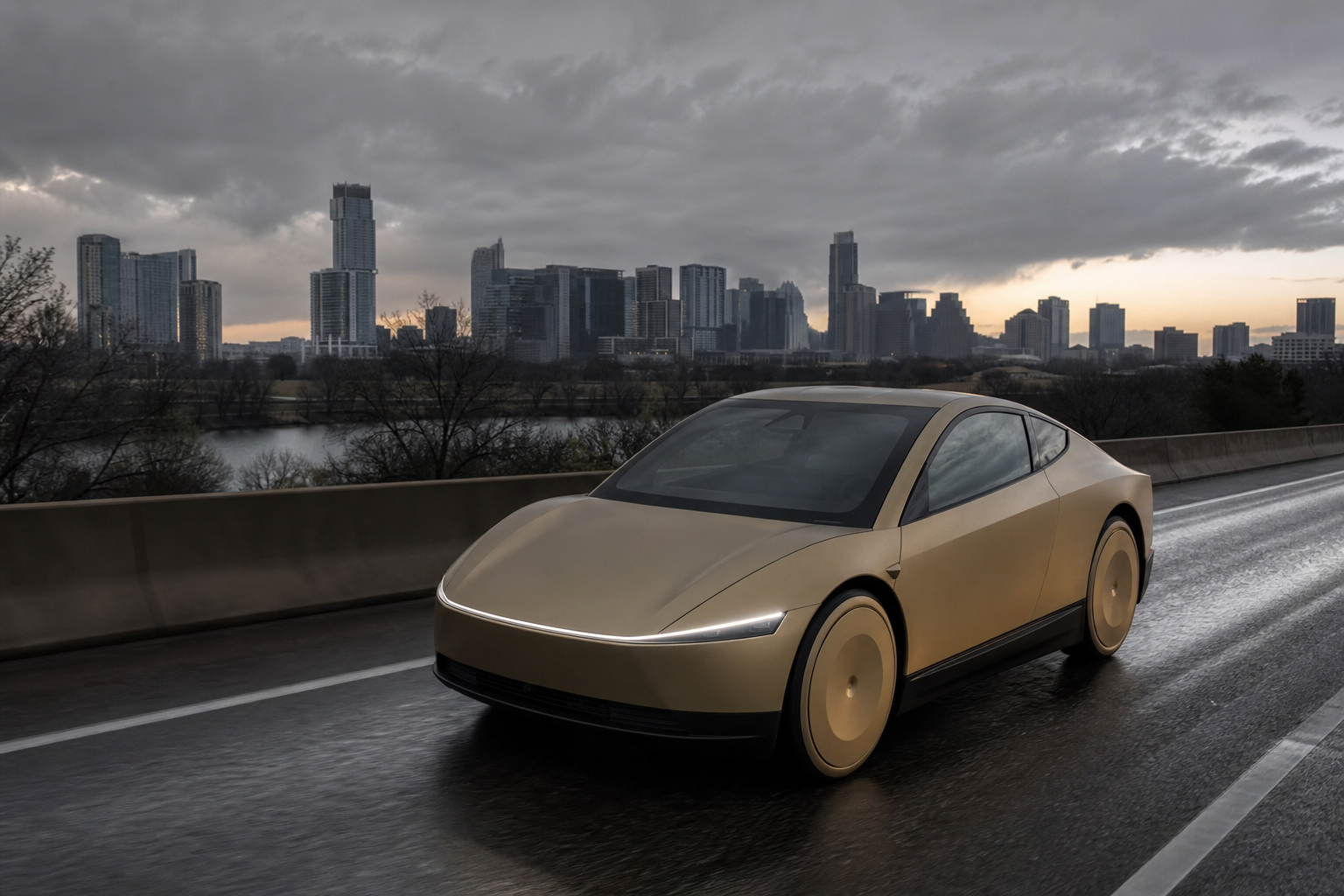
For riders in Austin, the street-level picture is unchanged by the commentary: a gold two-seater that can still be requested in the Robotaxi app while federal engineers examine the paperwork. For investors and operators watching the scale-up, Basher's point is the one worth holding: the investigation headline is not the story. The story is whether Cybercab exits the audit with a clear federal answer that pedals were never the safety case - and whether that answer becomes the precedent a mass fleet needs.
Priya Nair is a policy reporter covering AV regulation, state clearances, and FSD governance. Trained as a legal affairs reporter; files from the policy beat with an eye on what operators can actually ship.