Policy · Policy
Tesla Sends Out a Car With No Driver. A Visibility Probe Is Still Open.
NHTSA’s EA26002 covers 3.2 million supervised Teslas. The launch-day car has no wheel and no one to alert.
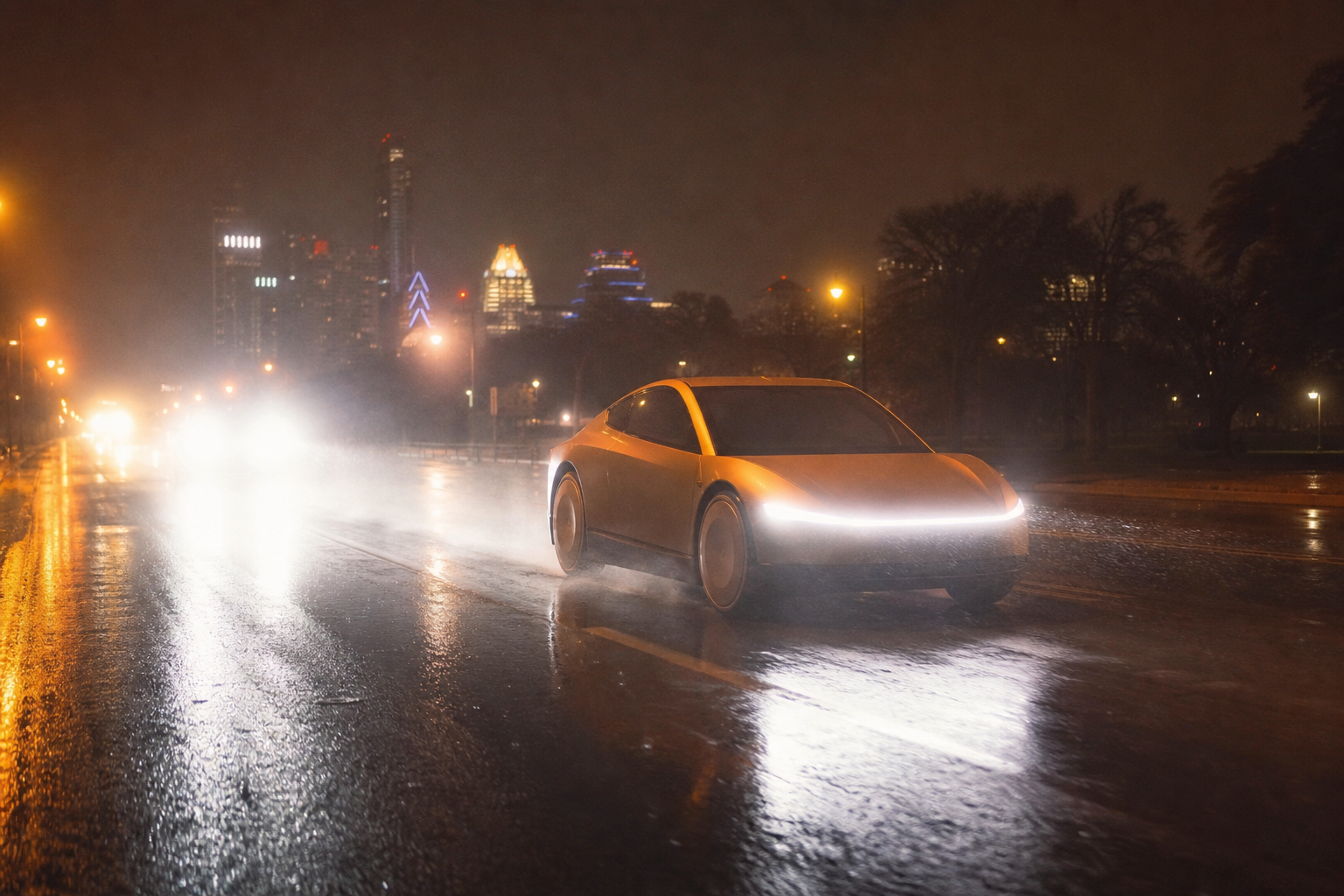
AUSTIN, Texas — Tesla’s Cybercab night arrives with a federal file still open on the software family that will drive it. NHTSA’s Engineering Analysis EA26002, opened March 18, is an investigation of Full Self-Driving in reduced visibility, covering about 3.2 million supervised Teslas. The car Tesla is showing tonight has no driver to warn.
The probe is not a Cybercab investigation. NHTSA opened it against FSD Beta and FSD (Supervised), the Level 2 systems that still require a person in the seat. The defect theory is specific. In crashes the Office of Defects Investigation reviewed, the system did not detect common conditions that impaired camera vision, and it did not warn the driver with enough time to respond. In those crashes, FSD also lost track of, or never saw, a lead vehicle.
CNBC and Electrek reported the upgrade from Preliminary Evaluation PE24031, opened in October 2024, to the engineering analysis in March. Electrek noted that an engineering analysis is the step that typically precedes a recall decision, not a recall itself. NHTSA has not ordered one. Tesla has said FSD is already many times safer than human drivers. Reuters, on Wednesday, put the company’s public claim as high as 10 times safer.
The launch-day problem is the missing person. Cybercab has no steering wheel and no pedals. Motor1 wrote this week that there is no way for a human inside to take over if the system misbehaves. The version of FSD that does not require a supervising driver is what Tesla says runs the two-seater. EA26002 is about whether a supervised system knows when its cameras have failed, and whether it tells a driver. A Cybercab has no driver to tell.
Tesla’s camera-only design is the through line. Waymo’s Aug. 26 blog argued that “cameras aren’t enough” and did not name Tesla. The timing still lands next to a camera-only Cybercab debut. Reuters noted that supervised FSD has faced federal investigations and lawsuits after collisions. Those cases are the supervised product. Thursday’s car is the unsupervised claim.
None of that proves a defect in Cybercab. It does mean Tesla is putting a vehicle with no manual backup onto public roads, or at least onto a guest loop, while the same agency that watches FSD is still asking whether the cameras know when they cannot see. Watch whether Tesla addresses that file tonight. Watch whether rides stay on campus. The software question does not reset because the invitations went out.
Priya Nair is a policy reporter covering AV regulation, state clearances, and FSD governance. Trained as a legal affairs reporter; files from the policy beat with an eye on what operators can actually ship.