Policy · Policy
NHTSA Opens an Audit of How Tesla Certified Its Wheel-Less Cybercab
Open Audit Query AQ26002 covers about 1,000 Cybercabs. The agency is asking how Tesla self-certified a car with no wheel, pedals or mirrors.
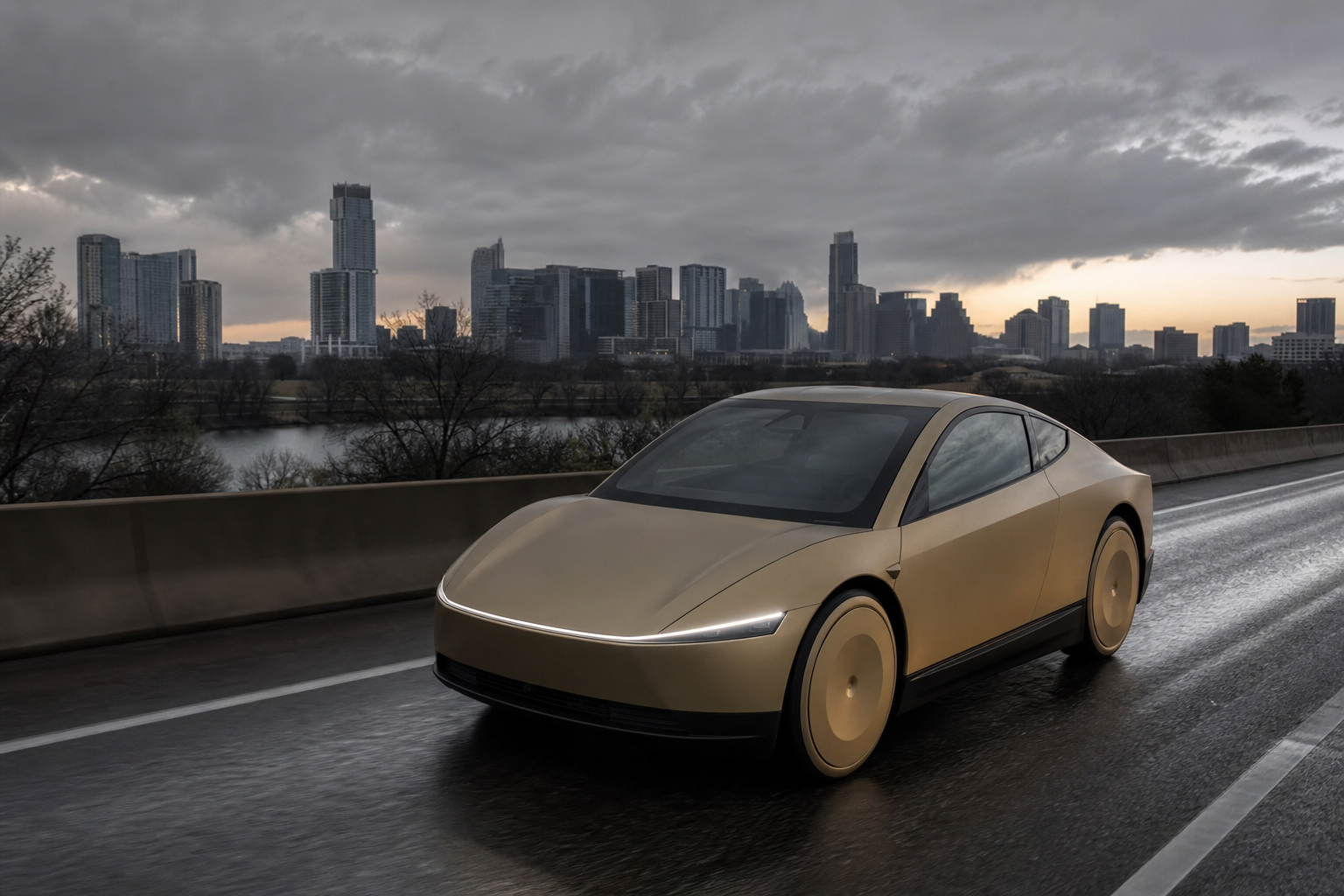
AUSTIN, Texas - A day after Tesla put production Cybercabs into paid Robotaxi service here, federal safety regulators opened a formal audit of how the company certified a car with no steering wheel, no pedals and no mirrors for the public roads.
The National Highway Traffic Safety Administration’s Office of Defects Investigation opened Open Audit Query AQ26002 on Sept. 3, the same day as Tesla’s invite-only Cybercab launch in Austin, according to the agency’s filing as reported by Electrek. The query covers an estimated 1,000 Cybercab vehicles and was “prompted by public information.” NHTSA’s announcement of the probe was reported Friday morning by Reuters, TechCrunch and other outlets.
The audit does not find that Cybercab is defective. It asks a narrower, foundational question: what process and technical data did Tesla use when it certified the vehicle as meeting Federal Motor Vehicle Safety Standards, and how far did that certification rest on a determination that some of those standards simply do not apply to a vehicle with no human driver controls.
NHTSA said the Cybercab lacks permanently attached conventional manual controls, including a steering wheel, brake pedal, accelerator pedal and mirrors. In the U.S. system, automakers generally self-certify compliance with FMVSS; the regulator can examine that work after the fact. Tesla told the agency it certified the vehicles as compliant with all applicable standards and that it plans to expand deployment gradually to more vehicles and more locations, according to the Electrek account of the filing.
“NHTSA fully supports the safe development and deployment of automated vehicles. But as the federal regulator, we need to ensure that all of our laws are followed,” administrator Jonathan Morrison said in a statement quoted by TechCrunch. “Our approach of balancing innovation with safety oversight will allow the United States to maintain its global leadership in AV innovation.”
The timing lands on top of a service that is already carrying people. At Thursday’s event, Ashok Elluswamy, Tesla’s vice president of AI, told attendees that Cybercab had been added to the public Robotaxi fleet and that anyone could take rides, Business Insider and other outlets reported. Tesla’s Robotaxi account separately said Cybercab rides open to the public Friday at 5 p.m. Central Time, moving the two-seater beyond the invite list. Booking remains through the Robotaxi app in limited areas of Austin. Texas records showed 420 autonomous vehicles registered to Tesla Robotaxi as of Friday morning, including 45 Cybercabs, Reuters reported - a small gold fleet beside hundreds of Model Y robotaxis.
That state paper trail is not the same as federal FMVSS clearance. Texas Senate Bill 2807, in effect since May 28, lets commercial autonomous operators attest to SAE Level 4 capability through the Motor Carrier Credentialing System. Tesla filed under that state framework; Thursday’s guest rides and Friday’s public window rest on that attestation plus Tesla’s own Robotaxi operations. A federal audit of self-certification is a separate layer. It does not, by itself, cancel Friday’s 5 p.m. CT opening. It does put the legal theory behind a wheel-less production taxi under Washington’s microscope while riders can still request one in the app.
Many FMVSS were written around a human driver: a wheel to turn, pedals to press, mirrors to check. Cybercab was designed without those parts. Tesla’s answer, as NHTSA frames the inquiry, was to decide that certain standards are inapplicable to a purpose-built autonomous vehicle. The agency says it will examine “the extent to which Tesla’s certification depended on determinations that certain FMVSS are inapplicable to the Cybercab.”
There is recent precedent. Amazon-owned Zoox self-certified a cube-like robotaxi without traditional controls; NHTSA opened a Special Order and later Audit Query AQ23001 into that certification, TechCrunch reported. Zoox eventually sought a demonstration path and later a temporary Part 555 exemption. NHTSA granted a Part 555 exemption in July 2026 that, among other limits, capped Zoox at 2,500 exempted vehicles per year for two years before the company opened commercial rides in Las Vegas. Whether Tesla faces a similarly long corridor is unclear. NHTSA said Friday it is updating parts of the FMVSS that relate to manual controls to “unleash American innovation,” and that it looks forward to finishing those updates “in the coming months.” Until then, the agency said, existing standards remain in force.
AQ26002 should also be kept distinct from other open Tesla files. NHTSA has a separate Engineering Analysis into supervised Full Self-Driving in reduced visibility covering about 3.2 million consumer vehicles. Cybercab’s Robotaxi software branch is not that consumer supervised build, even if both rest on camera-led autonomy. The new query is about the hardware certification of a vehicle that never had a driver’s station.
Tesla has not published a detailed public rebuttal to AQ26002 in the accounts reviewed for this report. The company has said Cybercab rides are available in limited areas of Austin through the Robotaxi app, and it has opened an interest form for businesses that want to help build the Robotaxi network, including future Cybercab fleet purchasing. Public sales of a wheel-less car to private owners remain a regulatory question of their own; Friday’s story is the federal look at how the first commercial units were cleared to roll.
For riders in Austin, the practical picture on Friday afternoon is still the one Tesla put on the calendar: a gold two-seater that can be requested in the Robotaxi app after 5 p.m. Central, subject to a small registered pool and ordinary dispatch luck, while NHTSA examines the paperwork that made that request legal. The audit is the news. The rides are already real.
Priya Nair is a policy reporter covering AV regulation, state clearances, and FSD governance. Trained as a legal affairs reporter; files from the policy beat with an eye on what operators can actually ship.